nLab D-brane
Context
String theory
Ingredients
Critical string models
Extended objects
Topological strings
Backgrounds
Phenomenology
Contents
- Idea
- Examples
- Properties
- Related concepts
- References
- General
- On orbifolds
- As higher super-GS-WZW type -models
- D-brane charge quantization in topological K-theory
- Origin and basics
- Twisted, equivariant and differential refinement
- Reviews
- Conceptual problems
- For orbifolds in equivariant K-theory
- Entropy
- For rational CFT
- Branes within branes
- For topological strings
- Open string worldsheet Anomaly cancellation
- Relation to Dirac structures
Idea
An abstractly defined -dimensional quantum field theory is a consistent assignment of state-space and correlators to -dimensional cobordisms with certain structure (topological structure, conformal structure, Riemannian structure, etc. see FQFT/AQFT). In an open-closed QFT the cobordisms are allowed to have boundaries.
In this abstract formulation of QFT a D-brane is a type of data assigned by the QFT to boundaries of cobordisms.
For a broader perspective see at brane.
In rational CFT
A well understood class of examples is this one: among all 2-dimensional conformal field theory that case of full rational 2d CFT has been understood completely, using FFRS-formalism. It is then a theorem that full 2-rational CFTs are classified by
-
a modular tensor category (to be thought of as being the category of representations of the vertex operator algebra of the 2d CFT);
-
a special symmetric Frobenius algebra object internal to .
In this formulation a type of brane of the theory is precisely an -module in (an -bimodule is a bi-brane or defect line ):
the 2d cobordisms with boundary on which the theory defined by carry as extra structure on their connected boundary pieces a label given by an equivalence class of an -module in . The assignment of the CFT to such a cobordism with boundary is obtained by
-
triangulating the cobordism,
-
labeling all internal edges by
-
labelling all boundary pieces by the -module
-
all vertices where three internal edges meet by the multiplication operation
-
and all points where an internal edge hits a boundary by the corresponding action morphism
-
and finally evaluating the resulting string diagram in .
So in this abstract algebraic formulation of QFT on the worldvolume, a brane is just the datum assigned by the QFT to the boundary of a cobordism. But abstractly defined QFTs may arise from quantization of sigma models. This gives these boundary data a geometric interpretation in some space. This we discuss in the next section.
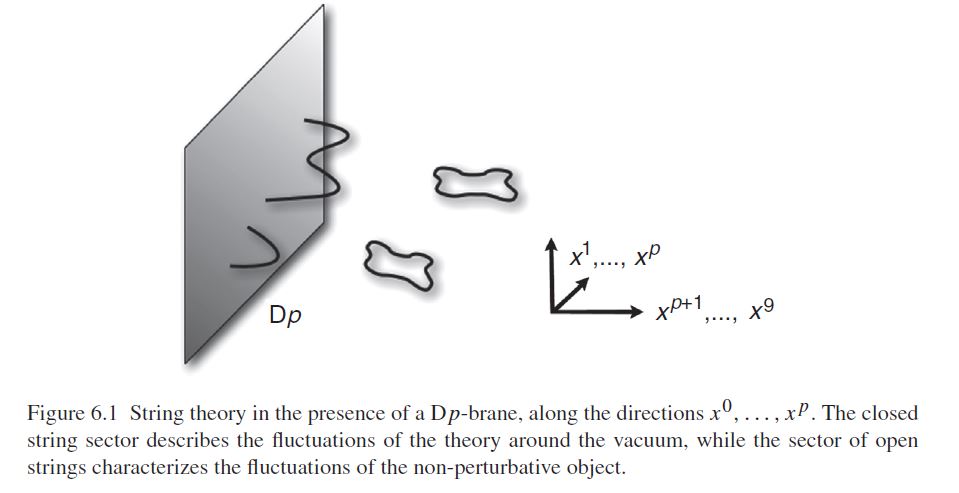
graphics grabbed from Ibanez-Uranga 12
In TFT
Another case where the branes of a QFT are under good mathematical control is TCFT: the (infinity,1)-category-version of a 2d TQFT.
Particularly the A-model and the B-model are well understood.
-
the branes of the B-model (“B-branes”) form the the stable (infinity,1)-category of chain complexes of quasicoherent sheaves on the target space (often considered just in terms of its homotopy category of an (infinity,1)-category, the derived category of quasicoherent sheaves);
-
the branes of the A-model form the Fukaya category of the target space.
-
the category of D-branes of the A-model on a symplectic Landau-Ginzburg model, is a Fukaya-Seidel category;
-
the category of D-branes of the B-model on a complex Landau-Ginzburg model is a category of matrix factorizations.
There is also a mathematical structure called string topology with D-branes. At present this is more “string inspired” than actually derived from string theory, though.
In terms of geometric data of the -model background
An abstractly defined QFT (as a consistent assignment of state spaces and propagators to cobordisms as in FQFT) may be obtained by quantization from geometric data :
Such a sigma-model QFT is the quantization of an action functional on a space of maps from a cobordism (“worldvolume”) to some target space that may carry further geometric data such as a Riemannian metric, or other background gauge fields.
One may therefore try to match the geometric data on that encodes the -model with the algebraic data of the FQFT that results after quantization. This gives a geometric interpretation to many of the otherwise purely abstract algebraic properties of the worldvolume QFT.
It turns out that if one checks which geometric data corresponds to the -modules in the above discussion, one finds that these tend to come from structures that look at least roughly like submanifolds of the target space . And typically these submanifolds themselves carry their own background gauge field data.
A well-understood case is the Wess-Zumino-Witten model: for this the target space is a simple Lie group and the background field is a circle 2-bundle with connection (a bundle gerbe) on , representing the background field that is known as the Kalb-Ramond field.
In this case it turns out that branes for the sigma model on are given in the simplest case by conjugacy classes inside the group, and that these carry twisted vector bundle with the twist given by the Kalb-Ramond background bundle. These vector bundles are known in the string theory literature as Chan-Paton vector bundles . The geometric intuition is that a QFT with certain boundary condition comes from a quantization of spaces of maps that are restricted to take the boundary of to these submanifolds.
More generally, one finds that the geometric data that corresponds to the branes in the algebraically defined 2d QFT is given by cocycles in the twisted differential K-theory of . These may be quite far from having a direct interpretation as submanifolds of .
The case of rational 2d CFT considered so far is only the best understood of a long sequence of other examples. Here the collection of all D-branes – identified with the collection of all internal modules over an internal frobenius algebra, forms an ordinary category.
More generally, at least for 2-dimensional TQFTs analogous considerations yield not just categories but stable (∞,1)-categories of boundary condition objects. For instance, for what is called the B-model 2-d TQFT the category of D-branes is the derived category of coherent sheaves on some Calabi-Yau space.
Starting with Kontsevich’s homological algebra reformulation of mirror symmetry the study of (derived) D-brane categories has become a field in its own right in pure mathematics.
… lots of further things to say …
As black branes
In perturbative string theory, hence for small string coupling constant the D-branes are incarnated as boundary conditions for the string’s worldsheet 2d CFT, exhibiting submanifolds in spacetime. As the string coupling constant increases and becomes non-perturbative, this picture of perturbative string theory breaks down, but at low energy (large scales) now supergravity becomes a good description, and now the D-branes are incarnated as black branes.
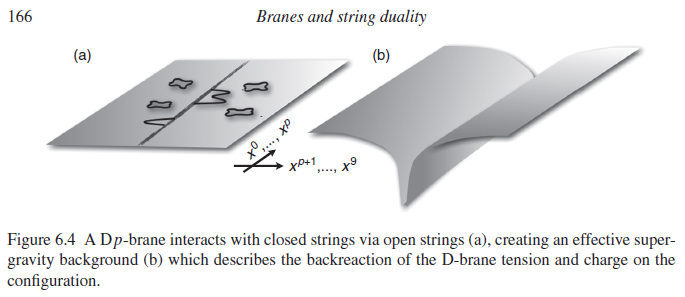
graphics grabbed from Ibanez-Uranga 12
This transition is also the key to understanding black holes in string theory.
1/2 BPS black branes in supergravity: D-branes, F1-brane, NS5-brane, M2-brane, M5-brane
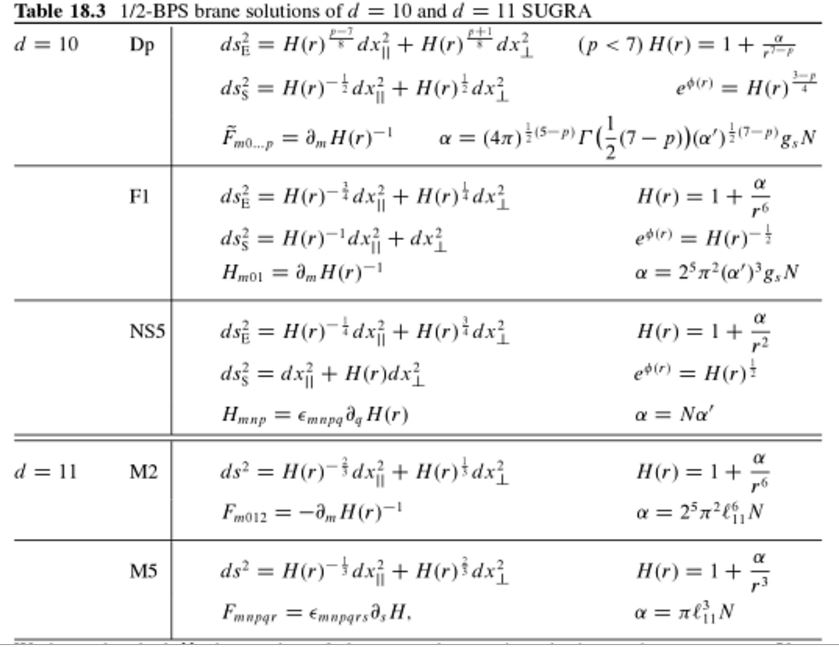
(table from Blumenhagen, Lüst & Theisen 2013, Chapter 18.5)
Examples
Various dimensions
In the WZW model
For D-branes in the WZW-model see WZW-model – D-branes.
Properties
As F-branes originating from M-branes
from M-branes to F-branes: superstrings, D-branes and NS5-branes
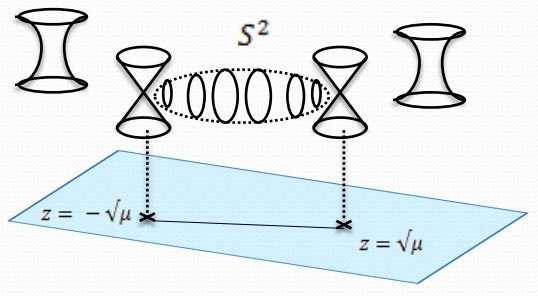 (
((e.g. Johnson 97, Blumenhagen 10)
Characterization in terms of Dirac structures
D-branes may be identified with Dirac structures on a Courant Lie 2-algebroid over spacetime related to the type II geometry (Asakawa-Sasa-Watamura). See at Dirac structure for more on this.
D-brane charge
In analogy to how in electromagnetism magnetic charge is given by a class in ordinary cohomology, so D-brane charge is given in (twisted) K-theory, or, if preferred, in its image under the Chern character.
The Chan-Paton bundle carried by a D-brane defines a class in twisted K-theory on the D-brane worldvolume and the D-brane charge is the push-forward (Umkehr map) of this class to spacetime, using a K-orientation of the embedding of the D-brane (a spin^c structure).
See at K-theory classification of D-brane charge
General
More in detail this means the following (BMRS2).
Let be a manifold regarded as spacetime and a submanifold regarded as the worldvolume of a D-brane. For the circle 2-bundle with connection which models the background B-field, write for the underlying circle 2-group-principal 2-bundle.
The corresponding Chan-Paton bundle (a twisted line bundle for the case of a single D-brane) is the trivialization in
Assuming that is K-oriented in that for instance has a spin-structure and a spin^c-structure, then under the groupoid convolution algebra functor this is incarnated as a Hilbert bimodule which defines a class in twisted operator K-theory, realized as the following comoposite in KK-theory
where
-
and are the C*-algebras of functions (vanishing at infinity) on the D-brane and on spacetime, respectively;
-
is the groupoid convolution algebra of sections of regarded as a centrally extended groupoid over a Cech groupoid resolution of which supports a Cech cocycle for , and similarly for and the pullback/restriction of the background B-field to the brane;
-
is the push-forward (Umkehr map) dual to , realizes as a KK-theory class
The corresponding D-brane charge in KK-theory is the resulting composite (relative index)
in twisted K-theory. Traditionally only the image of this under the Chern character
in real cohomology/cyclic cohomology is considered, . Moreover, traditonally one thinks of first applying to and then pushing forward in . By the C*-algebraic Grothendieck-Riemann-Roch theorem this gives the isomorphic expression
where on the right we have the relative Todd class. This is the form the D-brane charge was originally found in the physics literature and in which it is still often given.
(In (BMRS2, Section 4) this is discussed for the untwisted case.)
For more general discussion see at Freed-Witten anomaly – Details as well as at Poincaré duality algebra – Properties – K-Orientation and Umkehr maps.
Via the Atiyah-Hirzebruch spectral sequence
The Atiyah-Hirzeburch spectral sequence expresses, starting from its pages, K-theory classes on spacetime as kernels of certain differential acting on ordinary cohomology in all even degrees (for type IIA strings) or all odd degrees (for type IIB strings)
Discussion of D-brane charge this way is in (Maldacena-Moore-Seiberg 01, Evslin-Sati 06).
Related concepts
Table of branes appearing in supergravity/string theory (for classification see at brane scan).
∞-Chern-Simons theory from binary and non-degenerate invariant polynomial
(adapted from Ševera 00)
References
General
The original article is
-
Joseph Polchinski, Dirichlet-Branes and Ramond-Ramond Charges, Phys. Rev. Lett. 75 (1995) 4724-4727 [arXiv:hep-th/9510017, doi:10.1103/PhysRevLett.75.4724]
from p.7:
although it appears that we have modified the type II theory by adding something new to it, we are now arguing that these objects are actually intrinsic to any nonperturbative formulation of the type II theory; presumably one should think of them as an alternate representation of the black -branes
General review:
-
Joseph Polchinski, TASI Lectures on D-Branes [arXiv:hep-th/9611050]
-
Clifford Johnson, Études on D-Branes, in: Mike Duff et. al. (eds.) Nonperturbative aspects of strings, branes and supersymmetry, Proceedings, Trieste, Italy, March 23-April 3, (1998) [arXiv:hep-th/9812196, spire:481393]
-
Koji Hashimoto, D-Brane – Superstrings and New Perspective of Our World, Springer 2012 (doi:10.1007/978-3-642-23574-0, spire:1188897)
-
Pietro Fre, The Branes: Three Viewpoints, In: Gravity, a Geometrical Course Springer 2013 (spire:1242195, doi:10.1007/978-94-007-5443-0_7)
-
Constantin Bachas, D-branes [arXiv:2311.18456]
A classical text describing how the physics way to think of D-branes leads to seeing that they are objects in derived categories is
- Paul Aspinwall, D-Branes on Calabi-Yau Manifolds (arXiv:hep-th/0403166)
Discussion with an eye towards string phenomenology is in
- Luis Ibáñez, Angel Uranga, String Theory and Particle Physics – An Introduction to String Phenomenology, Cambridge University Press 2012
This can to a large extent be read as a dictionary from homological algebra terminology to that of D-brane physics.
More recent similar material with the emphasis on the K-theory aspects is
Comments on the role of D-branes in mathematical physics and mathematics is in
On orbifolds
Review includes
-
Frederik Roose, Strings and D-branes on orbifolds: from boundary states to geometry, 2001 (pdf)
-
Nikolas Prezas, Aspects of branes and orbifolds in string theory, 2002 (pdf, web)
See also the references at orientifold.
As higher super-GS-WZW type -models
The Green-Schwarz sigma model with DBI action for D-branes is discussed in
-
Martin Cederwall, Alexander von Gussich, Bengt Nilsson, Per Sundell, Anders Westerberg, The Dirichlet Super-p-Branes in Ten-Dimensional Type IIA and IIB Supergravity, Nucl.Phys. B490 (1997) 179-201 (arXiv:hep-th/9611159)
-
Mina Aganagic, Jaemo Park, Costin Popescu, John Schwarz, Dual D-Brane Actions, Nucl. Phys. B496 (1997) 215-230 (arXiv:hep-th/9702133)
Discussion of Green-Schwarz action functionals for super D-branes and the interpretation of the WZW cocycles for the D-branes as cocycles on “extended super-Minkowski spacetime” is due to
-
C. Chryssomalakos, José de Azcárraga, José M. Izquierdo, C. Pérez Bueno, The geometry of branes and extended superspaces, Nucl. Phys. B 567 (2000) 293-330 [arXiv:hep-th/9904137, doi:10.1016/S0550-3213(99)00512-X]
-
Makoto Sakaguchi, IIB-Branes and New Spacetime Superalgebras, JHEP 0004 (2000) 019 (arXiv:hep-th/9909143)
-
José de Azcárraga, J. M. Izquierdo, Superalgebra cohomology, the geometry of extended superspaces and superbranes (arXiv:hep-th/0105125)
See also division algebras and supersymmetry.
A corresponding discussion as ∞-Wess-Zumino-Witten theory and refinement of the brane scan to a “brane bouquet” of super L-∞ algebra extensions (hence in infinity-Lie theory via ∞-Wess-Zumino-Witten theory) is discussed in
-
Domenico Fiorenza, Hisham Sati, Urs Schreiber, Super Lie n-algebra extensions, higher WZW models and super p-branes with tensor multiplet fields, International Journal of Geometric Methods in Modern Physics Volume 12, Issue 02 (2015) 1550018 (arXiv:1308.5264)
-
Domenico Fiorenza, Hisham Sati, Urs Schreiber The WZW term of the M5-brane and differential cohomotopy, J. Math. Phys. 56, 102301 (2015) (arXiv:1506.07557)
-
Domenico Fiorenza, Hisham Sati, Urs Schreiber, Rational sphere valued supercocycles in M-theory and type IIA string theory (arXiv:1606.03206)
-
Vincent Braunack-Mayer, Hisham Sati, Urs Schreiber, Gauge enhancement of Super M-Branes (arXiv:1806.01115)
D-brane charge quantization in topological K-theory
On the conjectural D-brane charge quantization in topological K-theory:
Origin and basics
The idea that D-branes have Dirac charge quantization in topological K-theory originates with the observation that their charge expressed in RR-field flux densities resembles the image of a Chern character:
-
Michael Green, Jeffrey A. Harvey, Gregory Moore, I-Brane Inflow and Anomalous Couplings on D-Branes, Class. Quant. Grav. 14 (1997) 47-52 arXiv:hep-th/9605033, doi:10.1088/0264-9381/14/1/008
-
Ruben Minasian, Gregory Moore, K-theory and Ramond-Ramond charge, JHEP 9711:002 (1997) arXiv:hep-th/9710230, doi:10.1088/1126-6708/1997/11/002
Further early discussion:
-
Edward Witten, D-Branes And K-Theory, JHEP 9812:019 (1998) [arXiv:hep-th/9810188, doi:10.1088/1126-6708/1998/12/019]
-
Daniel Freed, Michael Hopkins, On Ramond-Ramond fields and K-theory, JHEP 0005 (2000) 044 arXiv:hep-th/0002027, doi:10.1088/1126-6708/2000/05/044
and with emphasis on the full picture of twisted differential K-theory in:
- Daniel Freed, Dirac charge quantization and generalized differential cohomology, Surveys in Differential Geometry, Int. Press, Somerville, MA, 2000, pp. 129–194 (arXiv:hep-th/0011220, doi:10.4310/SDG.2002.v7.n1.a6, spire:537392)
Here:
- Green, Harvey & Moore (1997), Minasian & Moore (1997) observe that RR-field flux form-expressions for D-brane charge look like images of K-theory classes under the Chern character;
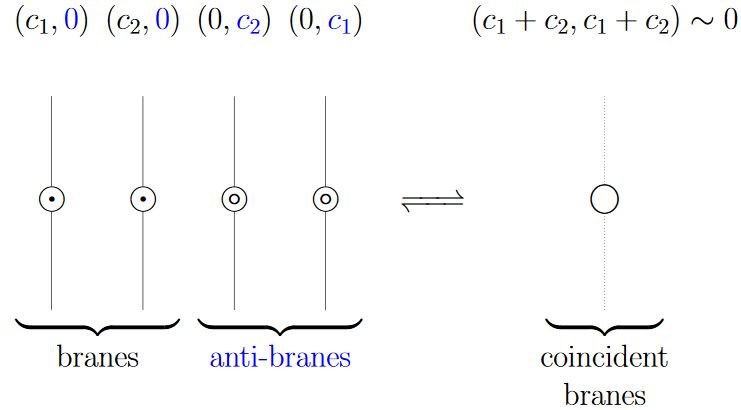
- Witten 98, Section 3 adds the observation that the tachyon condensation – which is expected (this is Sen's conjecture from Sen 98) for open strings between D-brane/anti-D-branes – plausibly implements on their Chan-Paton vector bundles the defining equivalence relation (here) of topological K-theory.
Expression of these D-brane K-theory classes via the Atiyah-Hirzebruch spectral sequence:
-
Juan Maldacena, Gregory Moore, Nathan Seiberg, D-Brane Instantons and K-Theory Charges, JHEP 0111:062,2001 (arXiv:hep-th/0108100)
-
Jarah Evslin, Hisham Sati, Can D-Branes Wrap Nonrepresentable Cycles?, JHEP0610:050,2006 (arXiv:hep-th/0607045)
Specifically for D-branes in WZW models see
- Peter Bouwknegt, A note on equality of algebraic and geometric D-brane charges in WZW models (pdf)
Understanding the solitonic (non-singular) D-branes and their T-duality in K-theory:
- Oren Bergman, Eric G. Gimon, Petr Hořava, Brane Transfer Operations and T-Duality of Non-BPS States, JHEP 9904 (1999) 010 [doi:10.1088/1126-6708/1999/04/010, arXiv:hep-th/9902160]
Towards a matrix model taking these K-theoretic effects into account (K-matrix model):
- Tsuguhiko Asakawa, Shigeki Sugimoto, Seiji Terashima, D-branes, Matrix Theory and K-homology, JHEP 0203 (2002) 034 arXiv:hep-th/0108085, doi:10.1088/1126-6708/2002/03/034
Twisted, equivariant and differential refinement
Discussion of charge quantization in twisted K-theory for the case of non-vanishing B-field:
-
Witten 98, Sec. 5.3 (for torsion twists)
-
Peter Bouwknegt, Varghese Mathai, D-branes, B-fields and twisted K-theory, Int. J. Mod. Phys. A 16 (2001) 693-706 arXiv:hep-th/0002023, doi:10.1088/1126-6708/2000/03/007
An elaborate proposal for the correct flavour of equivariant KR-theory needed for orientifolds is sketched in:
- Jacques Distler, Dan Freed, Greg Moore, Orientifold Précis in: Hisham Sati, Urs Schreiber (eds.) Mathematical Foundations of Quantum Field and Perturbative String Theory Proceedings of Symposia in Pure Mathematics, AMS (2011) (arXiv:0906.0795, slides)
Discussion of full-blown twisted differential K-theory and its relation to D-brane charge in type II string theory
- Daniel Grady, Hisham Sati, Ramond-Ramond fields and twisted differential K-theory, Advances in Theoretical and Mathematical Physics 26 5 (2022) doi:10.4310/ATMP.2022.v26.n5.a2, arXiv:1903.08843
Discussion of full-blown twisted differential orthogonal K-theory and its relation to D-brane charge in type I string theory (on orientifolds):
- Daniel Grady, Hisham Sati, Twisted differential KO-theory (arXiv:1905.09085)
Reviews
-
Kasper Olsen, Richard Szabo, Brane Descent Relations in K-theory, Nucl.Phys. B566 (2000) 562-598 (arXiv:hep-th/9904153)
-
Kasper Olsen, Richard Szabo, Constructing D-Branes from K-Theory, Adv. Theor. Math. Phys. 3 (1999) 889-1025 (arXiv:hep-th/9907140)
-
John Schwarz, TASI Lectures on Non-BPS D-Brane Systems (arXiv:hep-th/9908144)
-
Edward Witten, Overview Of K-Theory Applied To Strings, Int. J. Mod. Phys. A16:693-706, 2001 (arXiv:hep-th/0007175)
-
Greg Moore, K-Theory from a physical perspective, in: Ulrike Tillmann (ed.) Topology, Geometry and Quantum Field Theory, Proceedings of the 2002 Oxford Symposium in Honour of the 60th Birthday of Graeme Segal, Cambridge University Press (2004) (arXiv:hep-th/0304018, doi:10.1017/CBO9780511526398.011)
-
Juan José Manjarín, Topics on D-brane charges with B-fields, Int. J. Geom. Meth. Mod. Phys. 1 (2004) (arXiv:hep-th/0405074)
-
Jarah Evslin, What Does(n’t) K-theory Classify?, Modave Summer School in Mathematical Physics (arXiv:hep-th/0610328, spire:730502)
-
Stefan Fredenhagen, Physical Background to the K-Theory Classification of D-Branes: Introduction and References (doi:10.1007/978-3-540-74956-1_1), chapter in: Dale Husemoeller, Michael Joachim, Branislav Jurčo, Martin Schottenloher, Basic Bundle Theory and K-Cohomology Invariants, Lecture Notes in Physics, Springer (2008) 1-9 doi:10.1007/978-3-540-74956-1, pdf
-
Fabio Ruffino, Topics on topology and superstring theory (arXiv:0910.4524)
Amplification of torsion-charges implied by charge quantization in Ktheory
-
Volker Braun, K-Theory Torsion [arXiv:hep-th/0005103]
-
Ilka Brunner, Jacques Distler, Torsion D-Branes in Nongeometrical Phases, Adv. Theor. Math. Phys. 5 (2002) 265-309 [doi:10.4310/ATMP.2001.v5.n2.a3, arXiv:hep-th/0102018]
-
Ilka Brunner, Jacques Distler, Rahul Mahajan, Return of the Torsion D-Branes, Adv. Theor. Math. Phys. 5 (2002) 311-352 [doi:10.4310/ATMP.2001.v5.n2.a4, arXiv:hep-th/0106262]
Review of D-branes charge seen in KK-theory:
- Richard Szabo, D-branes and bivariant K-theory, Noncommutative Geometry and Physics 3 1 (2013): 131. (arXiv:0809.3029)
based on
-
Rui Reis, Richard Szabo, Geometric K-Homology of Flat D-Branes , Commun. Math. Phys. 266 (2006) 71-122 [arXiv:hep-th/0507043]
-
Jacek Brodzki, Varghese Mathai, Jonathan Rosenberg, Richard Szabo, D-Branes, RR-Fields and Duality on Noncommutative Manifolds, Commun. Math. Phys. 277 (2008) 643-706 arXiv:hep-th/0607020, doi:10.1007/s00220-007-0396-y
-
Jacek Brodzki, Varghese Mathai, Jonathan Rosenberg, Richard Szabo, Noncommutative correspondences, duality and D-branes in bivariant K-theory, Adv. Theor. Math. Phys. 13:497-552, 2009 (arXiv:0708.2648)
-
Jacek Brodzki, Varghese Mathai, Jonathan Rosenberg, Richard Szabo, D-branes, KK-theory and duality on noncommutative spaces, J. Phys. Conf. Ser. 103 012004 (2008) arXiv:0709.2128, doi:10.1088/1742-6596/103/1/012004
In particular (BMRS2) discusses the definition and construction of D-brane charge as a generalized index in KK-theory. The discussion there focuses on the untwisted case. Comments on the generalization of this to topologicall non-trivial B-field and hence twisted K-theory is in
- Richard Szabo, D-Branes, Tachyons and K-Homology, Mod. Phys. Lett. A17 (2002) 2297-2316 (arXiv:hep-th/0209210)
Conceptual problems
But there remain conceptual issues with the proposal that D-brane charge is in K-theory, as highlighted in
-
Jan de Boer, Robbert Dijkgraaf, Kentaro Hori, Arjan Keurentjes, John Morgan, David Morrison, Savdeep Sethi, section 4.5.2 and 4.6.5 of Triples, Fluxes, and Strings, Adv. Theor. Math. Phys. 4 (2002) 995-1186 [arXiv:hep-th/0103170, pdf]
-
Jarah Evslin, section 8 of: What Does(n’t) K-theory Classify?, Second Modave Summer School in Mathematical Physics [arXiv:hep-th/0610328]
In particular, actual checks of the proposal that D-brane charge is given by K-theory, via concrete computation in boundary conformal field theory, have revealed some subtleties:
-
Stefan Fredenhagen, Thomas Quella, Generalised permutation branes, JHEP 0511:004 (2005) [arXiv:hep-th/0509153, doi:10.1088/1126-6708/2005/11/004]
It might surprise that despite all the progress that has been made in understanding branes on group manifolds, there are usually not enough D-branes known to explain the whole charge group predicted by (twisted) K-theory. […] it is fair to say that a satisfactory answer is still missing.
The closest available towards an actual check of the argument for K-theory via open superstring tachyon condensation (Witten 98, Section 3) seems to be
- Theodore Erler, Analytic Solution for Tachyon Condensation in Berkovits’ Open Superstring Field Theory, JHEP 1311 (2013) 007 [doi:10.1007/JHEP11(2013)007, arXiv:1308.4400]
which, however, concludes (on p. 32) with:
It would also be interesting to see if these developments can shed light on the long-speculated relation between string field theory and the K-theoretic description of D-brane charge 75, 76, 77. We leave these questions for future work.
See also
- Theodore Erler, Four Lectures on Analytic Solutions in Open String Field Theory (arXiv:1912.00521, spire:1768105)
which still lists (on p. 112) among open problems of string field theory:
“Are there topological invariants of the open string star algebra representing D-brane charges?”
For orbifolds in equivariant K-theory
The proposal that D-brane charge on orbifolds is measured in equivariant K-theory (orbifold K-theory) goes back to
It was pointed out that only a subgroup of equivariant K-theory can be physically relevant in
- Jan de Boer, Robbert Dijkgraaf, Kentaro Hori, Arjan Keurentjes, John Morgan, David Morrison, Savdeep Sethi, around (137) of: Triples, Fluxes, and Strings, Adv.Theor.Math.Phys. 4 (2002) 995-1186 (arXiv:hep-th/0103170)
Further discussion of equivariant K-theory for D-branes on orbifolds includes the following:
-
Hugo García-Compeán, D-branes in orbifold singularities and equivariant K-theory, Nucl.Phys. B557 (1999) 480-504 (arXiv:hep-th/9812226)
-
Matthias Gaberdiel, Bogdan Stefanski, Dirichlet Branes on Orbifolds, Nucl.Phys.B578:58-84, 2000 (arXiv:hep-th/9910109)
-
Igor Kriz, Leopoldo A. Pando Zayas, Norma Quiroz, Comments on D-branes on Orbifolds and K-theory, Int. J. Mod. Phys. A 23 (2008) 933-974 [arXiv:hep-th/0703122]
-
Richard Szabo, Alessandro Valentino, Ramond-Ramond Fields, Fractional Branes and Orbifold Differential K-Theory, Commun.Math.Phys.294:647-702, 2010 (arXiv:0710.2773)
Discussion of real K-theory for D-branes on orientifolds includes the following:
The original observation that D-brane charge for orientifolds should be in KR-theory is due to
and was then re-amplified in
-
Sergei Gukov, K-Theory, Reality, and Orientifolds, Commun.Math.Phys. 210 (2000) 621-639 (arXiv:hep-th/9901042)
-
Oren Bergman, E. Gimon, Shigeki Sugimoto, Orientifolds, RR Torsion, and K-theory, JHEP 0105:047, 2001 (arXiv:hep-th/0103183)
With further developments in
- Varghese Mathai, Michael Murray, Daniel Stevenson, Type I D-branes in an H-flux and twisted KO-theory, JHEP 0311 (2003) 053 (arXiv:hep-th/0310164)
Discussion of orbi-orienti-folds using equivariant KO-theory is in
-
N. Quiroz, Bogdan Stefanski, Dirichlet Branes on Orientifolds, Phys.Rev. D66 (2002) 026002 (arXiv:hep-th/0110041)
-
Volker Braun, Bogdan Stefanski, Orientifolds and K-theory (arXiv:hep-th/0206158)
-
H. Garcia-Compean, W. Herrera-Suarez, B. A. Itza-Ortiz, O. Loaiza-Brito, D-Branes in Orientifolds and Orbifolds and Kasparov KK-Theory, JHEP 0812:007, 2008 (arXiv:0809.4238)
Discussion of the alleged K-theory classification of D-brane charge in relation to the M-theory C-field is in
- Duiliu-Emanuel Diaconescu, Gregory Moore, Edward Witten, Gauge Theory, and a Derivation of K-Theory from M-Theory, Adv.Theor.Math.Phys.6:1031-1134,2003 (arXiv:hep-th/0005090), summarised in A Derivation of K-Theory from M-Theory (arXiv:hep-th/0005091)
See also
- Inaki Garcia-Etxebarria, Angel Uranga, From F/M-theory to K-theory and back, JHEP 0602:008,2006 (arXiv:hep-th/0510073)
More complete discussion of double dimensional reduction of the supergravity C-field in 11d to the expected B-field and RR-field flux forms in 10d:
-
Varghese Mathai, Hisham Sati, Some Relations between Twisted K-theory and Gauge Theory, JHEP0403:016,2004 (arXiv:hep-th/0312033)
-
Domenico Fiorenza, Hisham Sati, Urs Schreiber, Rational sphere valued supercocycles in M-theory and type IIA string theory, Journal of Geometry and Physics, Volume 114, Pages 91-108 April 2017 (arXiv:1606.03206, doi:10.1016/j.geomphys.2016.11.024)
Entropy
The entropy of D-branes scales with the square of their number:
Around equation (3) in
- Steven Gubser, Igor Klebanov Arkady Tseytlin, Coupling Constant Dependence in the Thermodynamics of Supersymmetric Yang-Mills Theory, Nucl. Phys. B534:202-222, 1998 (arXiv:hep-th/9805156)
Around (3) in:
- Igor Klebanov, From Threebranes to Large Gauge Theories (arXiv:hep-th/9901018)
Around equation (5.5) in:
- Elias Kiritsis, T.R. Taylor, Thermodynamics of D-brane Probes (arXiv:hep-th/9906048)
See also:
-
Mark van Raamsdonk, The Amazing Matrix in String Theory (2006):
Most of the dramatic progress in string theory over the past decade has in some way involved the degrees of freedom of D-branes, solitonic objects in string theory whose low energy physics is described by quantum field theories living on the branes. Essential to many of the applications of D-brane physics is the fact that the number of degrees of freedom of a collection of branes scales not as the number of branes, but as the square of the number of branes.
Around (1.1) in:
- Qianqian Du, Michael Strickland, Ubaid Tantary, supersymmetric Yang-Mills thermodynamics to order (arXiv:2105.02101)
For rational CFT
For exhaustive details on D-branes in 2-dimensional rational CFT see the references given at
Branes within branes
- Michael Douglas, Branes within Branes (arXiv:hep-th/9512077)
For topological strings
A discussion of topological D-branes in the context of higher category theory is in
- Anton Kapustin, Topological Field Theory, Higher Categories, and Their Applications (arXiv:1004.2307)
Open string worldsheet Anomaly cancellation
The need for twisted spin^c structures as quantum anomaly-cancellaton condition on the worldvolume of D-branes was first discussed in
- Daniel Freed, Edward Witten, Anomalies in String Theory with D-Branes (arXiv:hep-th/9907189)
More details are in
- Anton Kapustin, D-branes in a topologically nontrivial B-field , Adv. Theor. Math. Phys.
4, no. 1, pp. 127–154 (2000), (arXiv:hep-th/9909089)
A clean review is provided in
- Kim Laine, Geometric and topological aspects of Type IIB D-branes (arXiv:0912.0460)
For more see at Freed-Witten anomaly cancellation.
Relation to Dirac structures
- Tsuguhiko Asakawa, Shuhei Sasa, Satoshi Watamura, D-branes in Generalized Geometry and Dirac-Born-Infeld Action (arXiv:1206.6964)
Last revised on January 25, 2024 at 14:13:38. See the history of this page for a list of all contributions to it.