nLab nerve
Context
Category theory
Concepts
Universal constructions
Theorems
Extensions
Applications
Contents
The nerve is the right adjoint of a pair of adjoint functors that exists in many situations. For the general abstract theory behind this see
Idea
As soon as any locally small category comes equipped with a cosimplicial object
that we may think of as determining a realization of the standard -simplex in , we make every object of probeable by simplices in that there is now a way to find the set
of ways to map the -simplex into a given object .
These collections of sets evidently organize into a simplicial set
This simplicial set is called the nerve of (with respect to the chosen realization of the standard simplices in ). Typically the nerve defines a functor that has a left adjoint called realization.
There are many generalizations of this procedure, some of which are described below.
Definition
(notice that for the moment the following gives just one particular case of the more general notion of nerve)
Let be one of the categories of geometric shapes for higher structures, such as the globe category , the simplex category , the cube category , the cycle category of Connes, or certain category related to trees whose corresponding presheaves are dendroidal sets.
If is any locally small category or, more generally, a -enriched category equipped with a functor
we obtain a functor
from to globular sets or simplicial sets or cubical sets, respectively, (or the corresponding -objects) given on an object by the restricted Yoneda embedding
This is the nerve of with respect to the chosen . In other words, where is the curried Hom functor; if then is the Yoneda embedding.
Typically, one wants that is dense functor, i.e. that every object of is canonically a colimit of a diagram of objects in , more precisely,
which is equivalent to the requirement that the corresponding nerve functor is fully faithful (in other words, if is inclusion then is a left adequate subcategory of in terminology of Isbell 60). The nerve functor may be viewed as a singular functor? of the functor .
Examples
Nerve of a 1-category
For fixing notation, recall that the source and target maps of a small category form a span in the category where composition is given by a pullback (fiber product). The pairs of composable morphisms of a category are then obtained composing its source/target span with itself.
Definition
A small category is
-
a pair of sets (the set of objects) and (the set of morphisms)
-
equipped with functions
where the fiber product on the left is that over ,
such that
-
takes values in endomorphisms;
-
defines a partial composition operation which is associative and unital for the identities; in particular
and .
Definition
Definition
For a small category, def. , its simplicial nerve is the simplicial set with
the set of sequences of composable morphisms of length , for ;
with face maps
being
-
for , , whilst is similarly the domain / source function;
-
for
-
the two outer face maps and are given by forgetting the first and the last morphism in such a sequence, respectively;
-
the inner face maps are given by composing the th morphism with the st in the sequence.
-
The degeneracy maps
are given by inserting an identity morphism on .
Remark
Spelling this out in more detail: write
for the set of sequences of composable morphisms. Given any element of this set and , write
for the composition of the two morphism that share the th vertex.
With this, face map acts simply by “removing the index ”:
Similarly, writing
for the identity morphism on the object , then the degeneracy map acts by “repeating the th index”
This makes it manifest that these functions organise into a simplicial set.
More abstractly, this construction is described as follows. Recall that
Definition
The simplex category is equivalent to the full subcategory
of Cat on non-empty finite linear orders regarded as categories, meaning that the object may be identified with the category . The morphisms of are all functors between these total linear categories.
Definition
For a small strict category its nerve is the simplicial set given by
where Cat is regarded as a 1-category with objects locally small strict categories, and morphisms being functors between these.
So the set of -simplices of the nerve is the set of functors . This is clearly the same as the set of sequences of composable morphisms in of length obtained by iterated fiber product (as above for pairs of composables):
The collection of all functors between linear orders
is generated from those that map almost all generating morphisms to another generating morphism, except at one position, where they
-
map a single generating morphism to the composite of two generating morphisms
-
map one generating morphism to an identity morphism
It follows that, for instance
-
for the image under is obtained by composing the first two morphisms in this sequence:
-
for the image under is obtained by inserting an identity morphism: .
In this way, generally the face and degeneracy maps of the nerve of a category come from composition of morphisms and from inserting identity morphisms.
In particular in light of their generalization to nerves of higher categories, discussed below, the cells in the nerve have the following interpretation:
-
is the collection of objects of ;
-
is the collection of morphisms of ;
-
is the collection of composable morphisms in as in the diagram
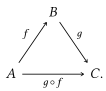 The 2-cell itself is to be read as the composition operation, which is unique for an ordinary category (there is just one way to compose two morphisms);
 -
is the collection of triples of composable morphisms as in the diagram
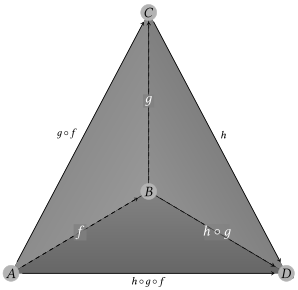 to be read as the unique associators that relate one way to compose three morphisms using the above 2-cells to the other way.
Examples
Example
(bar construction)
Let be a monoid (for instance a group) with multiplication , and write for the corresponding one-object category with . Then the nerve of is the simplicial set which is given by a two-sided bar construction of , namely :
where for example the three parallel face maps on display are .
In particular, when is a discrete group, then the geometric realization of the nerve of is the classifying topological space for -principal bundles.
Properties
The following lists some characteristic properties of simplicial sets that are nerves of categories.
Proposition
A simplicial set is the nerve of a category precisely if it satisfies the Segal condition.
See at Segal condition for more on this.
Proposition
A simplicial set is the nerve of a small category precisely if all *inner* horns have unique fillers.
(e.g. Kerodon, Prop. 1.2.3.1; see also at inner fibration.)
Proposition
A simplicial set is the nerve of a groupoid precisely if all horns of dimension have unique fillers.
(cf. e.g. Kerodon, Prop. 1.2.4.2)
Here the point as compared to the previous statements is that in particular all the outer horns have fillers for .
Proposition
The nerve of a small category is a Kan complex precisely if is a groupoid.
The existence of inverse morphisms in corresponds to the fact that in the Kan complex the “outer” horns
have fillers
(even unique fillers, due to the above).
It suggests the sense that a Kan complex models an ∞-groupoid. The possible lack of uniqueness of fillers in general gives the ‘weakness’ needed, whilst the lack of a coskeletal property requirement means that the homotopy type it represents has enough generality, not being constrained to be a 1-type.
Proposition
The nerve functor (on small strict categories) is a fully faithful functor.
(e.g Kerodon, Prop. 1.2.2.1; Rezk 2022, Prop. 4.10)
So functors between locally small categories are in bijection with morphisms of simplicial sets between their nerves.
Proposition
The nerve functor (on small strict categories) preserves finite products, in that it sends:
-
the terminal category to the terminal simplicial set,
-
any product category to the product of simplicial sets of the nerves of the factors:
Proof
By direct inspection, using that the morphisms in a product category are just pairs of morphisms of the two factor categories.
Proposition
The nerve functor sends functor categories to the function complexes between the separate nerves:
Proof
For we have the following sequence of natural isomorphisms:
Here
-
the first step follows as discussed at natural transformation (here);
Proposition
A simplicial set is the nerve of a locally small category precisely if it satisfies the Segal conditions: precisely if all the commuting squares
are pullback diagrams.
Unwrapping this definition inductively in , this says that a simplicial set is the nerve of a category if and only if all its cells in degree are unique compositors, associators, pentagonators, etc of composition of 1-morphisms. No non-trivial such structure cells appear and no further higher cells appear.
This characterization of categories in terms of nerves directly leads to the model of (∞,1)-category in terms of complete Segal spaces by replacing in the above discussion sets by topological spaces (or something similar, like Kan complexes) and pullbacks by homotopy pullbacks.
Proposition
The nerve of a category is 2-coskeletal.
Hence in the nerve of a category, all horn inclusions have unique fillers for , and all boundary inclusions have unique fillers for .
In summary:
Example
(coskeletality of simplicial nerves of categories)
The simplicial nerve of a category (i.e. of a 1-category) is a 2-coskeletal simplicial set (Prop. ): The unique filler of the boundary of an -simplex encodes the associativity-condition on -tuples of composable morphisms.
Of course there is more to a category than its associativity condition, and hence the converse fails: Not every 2-coskeletal simplicial set is the nerve of a category. For example the boundary of the 2-simplex, , is 2-coskeletal but not the nerve of a category, since it is missing a composition of the edges , namely it is missing a filler of this inner horn.
In fact, a simplicial set is the nerve of a category iff it has unique inner -horn-fillers for (Prop. ). But 2-coskeletality already implies that all -horns have unique filles (first uniquely fill the missing -face then the interior )-cell. Together this implies that:
A simplicial set is the nerve of a category iff
-
it is 2-coskeletal,
-
all inner 2- and 3-horns have unique fillers (encoding composition and associativity).
Similarly for groupoids (byProp. ):
A simplicial set is the nerve of a groupoid iff
-
it is 2-coskeletal,
-
all 2- and 3-horns have unique fillers.
For better or worse, such a simplicial set has at times also been called a 1-hypergroupoid, pointing to the fact that this is the first non-trivial stage in a pattern that recognizes -coskeletal Kan complexes with unique horn fillers as models for -groupoids
Notice that a Kan complex which is 2-coskeletal but with possibly non-unique 2-horn fillers is still a homotopy 1-type and may still be called a 1-groupoid in the sense of homotopy theory, but need not be the nerve of a groupoid. It may be thought of as a bigroupoid (2-hypergroupoid) which happens to be just a homotopy 1-type.
Nerve of a 2-category
For 2-categories modeled as bicategories the nerve operation is called the Duskin nerve.
Proposition
A simplicial set is the Duskin nerve of a bigroupoid precisely if it is a 2-hypergroupoid: a Kan complex such that the horn fillers in dimension are unique.
This is theorem 8.6 in (Duskin)
For a 2-category, regarded as a Cat-internal category one can apply the nerve operation for categories in stages, to obtain the double nerve.
Nerve of a 3-category
One also has a nerve operation for 3-categories modeled as tricategories: the Street nerve.
Proposition
A simplicial set is the Street nerve of a trigroupoid? precisely if it is a 3-hypergroupoid: a Kan complex such that the horn fillers in dimension are unique.
This is the main result of (Carrasco, 2014).
Nerve of an -category
- For strict omega-categories there is a nerve induced by the orientals; see omega-nerve.
Nerve of chain complexes
Let be the category of chain complexes of abelian groups, then there is a cosimplicial chain complex
given by sending the standard -simplex first to the free simplicial group over it and then that to the normalized Moore complex. This is a small version of the ordinary homology chain complex of the standard -simplex.
The nerve induced by this cosimplicial object was first considered in
- D. Kan, Functors involving c.s.s complexes, Transactions of the American Mathematical Society, Vol. 87, No. 2 (Mar., 1958), pp. 330–346 (jstor)
The nerve/realization adjunction induced from this is the Dold-Kan correspondence. See there for more details.
Remarks
Geometric realization
Often the operation of taking the nerve of a (higher) category is followed by forming the geometric realization of the corresponding cellular set.
Nerves and higher categories
For many purposes it is convenient to conceive categories and especially ∞-categories entirely in terms of their nerves: those simplicial sets that arise as certain nerves are usually characterized by certain properties. So one can turn this around and define an ∞-category as a simplicial set with certain properties. This is the strategy of a geometric definition of higher category. Examples for this are complicial sets, Kan complexes, quasi-categories, simplicial T-complexes,…
Internal nerve
A variant of the nerve construction can also be applied internally within a category, to any internal category, see the discussion at internal category.
Direct categories versus finite simplicial sets
If a direct category has finitely many objects then its nerve is a finite simplicial set. Conversely, if a finite simplicial set is the nerve of a category then the category is a direct category with finitely many objects.
Properties
(Non-)Preservation of colimits
While the nerve operation is a right adjoint (this Prop.) and hence preserves all limits, the nerve operation does not preserve all colimits (Exp. ), hence is not a left adjoint.
However, it does preserve some colimits (Exp. ); rather special ones, but of central importance in the theory of classifying spaces constructed via geometric realization of simplicial topological spaces (Exp. ).
(In the following Exp. we use “card” instead of the more common notation “” for cardinality (of underlying sets) in order not to clash with the notation for geometric realization, even if the latter is not directly involved in the following examples.)
Example
(Nerve does not preserve quotients of delooping groupoids by normal subgroups)
Let be the inclusion of a non-trivial normal subgroup of a finite group , with its quotient group denoted .
Then the cardinalities of the th component sets of the nerves
of their delooping groupoids
satisfy, from degree on, an inequality relation:
But this means that it is impossible for there to be an isomorphism (namely a degree-wise bijection) from to , and hence that it is impossible for the nerve operation to preserve the colimit which is the quotient by the -action.
Example
(nerve does preserve canonical quotients of chaotic groupoids of groups)
For a (discrete) group, write
-
for its delooping groupoid;
-
for its pair groupoid equipped with the usual left -action (discussed there),
so that the quotient coprojection of this action is
Noticing that the nerve of (which is the universal principal simplicial complex ) has component sets
with the action given degreewise by left-multiplication on just the leftmost factor (see also this exp.), we have
and hence here the nerve operation does preserve the quotient coprojection (1):
The result is the universal simplicial principal bundle of regarded as a simplicial group.
Remark
The joint relevance of Exp. and Exp. has been highlighted in Guillou, May & Merling 2017 (corresponding there to Exp. 2.9 and Lem. 2.10 – but Exp. 2.9 seems a little broken (?) while Lem. 2.10 does not quite get around to discussing the quotienting, for which it seems to be quoted later on).
The principle behind Exp. is readily seen to be, more generally, the following:
Example
(nerve preserves left quotients of right action groupoids)
For a pair of groups, let be a set equipped with a left action of and a commuting right action of .
Then the action groupoid of the right -action inherits the residual -action
and the quotient by this left action is preserved by the nerve operation:
Related concepts
References
For covers
The notion of the nerve of a cover (in modern parlance: of its Cech groupoid) appears in:
- Paul Alexandroff, Section 9 of: Über den allgemeinen Dimensionsbegriff und seine Beziehungen zur elementaren geometrischen Anschauung, Mathematische Annalen 98 (1928), 617–635 (doi:10.1007/BF01451612).
For categories
The notion of the nerve of a general category already appears in
- Alexander Grothendieck, above Proposition 4.1 of: Techniques de construction et théorèmes d’existence en géométrie algébrique III : préschémas quotients, Séminaire Bourbaki : années 1960/61, exposés 205-222, Séminaire Bourbaki, no. 6 (1961), Exposé no. 212, (numdam:SB_1960-1961__6__99_0, pdf)
Another early appearance in print is:
-
Graeme Segal, Section 2 of: Classifying spaces and spectral sequences, Publications Mathématiques de l’IHÉS, Volume 34 (1968), p. 105-112 (numdam:PMIHES_1968__34__105_0)
(in the context of constructing classifying spaces for principal bundles in algebraic topology)
Review and exposition:
-
Saunders MacLane, §XII.2 of: Categories for the Working Mathematician, Graduate Texts in Mathematics 5 Springer (second ed. 1997) [doi:10.1007/978-1-4757-4721-8]
-
Charles Rezk, Part 1 of: Introduction to quasicategories (2022) [pdf, pdf]
See also:
-
Tom Leinster, p. 117 onwards in: Higher operads, higher categories , London Mathematical Society Lecture Note Series, 298. Cambridge Univ. Press 2004. xiv+433 pp. ISBN: 0-521-53215-9 (arXiv:math.CT/0305049)
-
Tom Leinster, How I learned to love the nerve construction, -Category Café, January 6, 2008.
(an explanation of how the simplex category and the nerve construction arise canonically from the free category monad)
See also:
-
John Isbell, Adequate subcategories, Illinois J. Math. 4, 541–552 (1960) (doi:10.1215/ijm/1255456274)
-
W. G. Dwyer, D. M. Kan, Singular functors and realization functors, Nederl. Akad. Wetensch. Indag. Math. 46 (1984), no. 2, 147–153. pdf
For higher categories
- Ross Street, The algebra of oriented simplexes, J. Pure Appl. Algebra 49 (1987) 283-335; MR89a:18019 (pdf, doi:10.1016/0022-4049(87)90137-X).
For 2-categories and bicategories:
-
Manuel Bullejos, Antonio M. Cegarra, On the geometry of 2-categories and their classifying spaces, K-Theory 29 3 (2003) 211-229 [doi:10.1023/B:KTHE.0000006921.50151.00, pdf]
-
Stephen Lack, Simona Paoli, 2-nerves for bicategories, K-Theory 38 (2008) [arXiv:math/0607271, doi:10.1007/s10977-007-9013-2]
-
Paul Bressler, Alexander Gorokhovsky, Ryszard Nest, Boris Tsygan, Formality for algebroids I: Nerves of two-groupoids [arxiv:1211.6603v3]
For 3-categories:
- Pilar Carrasco, Nerves of Trigroupoids as Duskin-Glenn’s -Hypergroupoids, Applied Categorical Structures 23.5 (2015): 673-707 (doi:10.1007/s10485-014-9374-7)
Last revised on April 16, 2024 at 06:36:56. See the history of this page for a list of all contributions to it.