nLab virtual double category
Context
2-Category theory
Definitions
Transfors between 2-categories
Morphisms in 2-categories
Structures in 2-categories
Limits in 2-categories
Structures on 2-categories
Contents
Idea
A virtual double category or -multicategory is a common generalization of a monoidal category, a bicategory, a double category, and a multicategory. It contains:
- objects
- vertical arrows, which form a category
- horizontal arrows, which do not have identities or composites, and
- 2-cells which have
- a horizontal source and target, which are vertical arrows,
- a vertical target, which is a horizontal arrow, and
- a vertical source, which is a composable string of horizontal arrows.
2-cells are usually drawn like this:
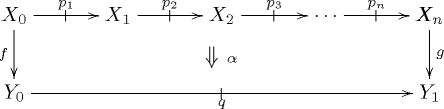
Note that this includes the case when , i.e. a cell of “nullary” source. In this case, we must have .
Note that the “empty” case of a string of horizontal arrows this has a single object in which case the 2-cell looks like:
Finally, the 2-cells can be composed in a more or less evident way, akin to composition in a multicategory:
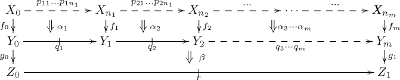
Virtual double categories are related to double categories precisely as ordinary multicategories are related to monoidal categories (see generalized multicategory and tensor product).
Definition
A virtual double category can be defined in two equivalent ways:
-
It is a -multicategory, in the sense of Leinster, relative to the monad on directed graphs whose algebras are categories. For this reason, Leinster originally called them fc-multicategories, where “fc” is a name for this monad which stands for “free-category.”
-
It is a generalized multicategory, in the sense of Hermida, Cruttwell-Shulman, and others, relative to the monad on graphs-internal-to-Cat whose algebras are double categories. This is the origin of the name “virtual double category,” in line with the general terminology “virtual -algebra” of Cruttwell-Shulman for such generalized multicategories.
We can also give an explicit definition, which was more or less already given in the “Idea” section: all that is missing are identities and associativity for 2-cell composition.
Examples
- Any double category is an example, and thus also any bicategory viewing the arrows as horizontal.
- For any monoidal category , there is a virtual double category of -matrices whose objects are sets, vertical arrows are functions and a horizontal arrow is a family of objects for each , and a 2-cell from to along is a family of arrows in (using the unit of the monoidal category if the source string is empty). If has certain colimits that are preserved by then composites exist and this virtual double category is pseudo.
- Given a monad on a virtual double category, the horizontal kleisli double category produces a virtual double category that is only pseudo under strong conditions on the monad. In particular, “free monoid” monad on the double category of sets and spans does not produce a pseudo double category.
Higher categories of virtual double categories
There are notions of functor, transformation, and profunctor between virtual double categories. The neatest way to define all of these notions at once is to use the general framework of generalized multicategories: from the monad on the virtual equipment we can construct a new virtual equipment whose objects are virtual double categories, whose arrows are functors between them, whose proarrows are profunctors between them, and whose cells are transformations. But we can also give explicit definitions of all of these notions.
Functors and transformations
A functor of virtual double categories is fairly obvious; it takes each kind of morphism/cell to the same kind, preserving sources, targets, composition, and identities.
The relevant transformations are a “virtual” version of vertical transformations between ordinary double categories. Specifically, a transformation has a vertical arrow component for each object of the domain, and a cell component
for each horizontal arrow in the domain. These must be natural with respect to vertical composition of arrows and of 2-cells, where we must of course allow composites with arbitrary arities in the latter case.
Virtual double categories, functors, and transformations form a strict 2-category, and thus we can apply all notions of 2-category theory to it. In particular, we have a notion of a monad on a virtual double category, which is the starting point for one theory of generalized multicategories.
Profunctors
The profunctors between virtual double categories are a similar “virtualization” of the notion of double profunctor between double categories. Explicitly, a profunctor consists of:
-
An ordinary profunctor between the categories of objects and vertical arrows.
-
For each string of horizontal arrows in , each horizontal arrow in , and each pair of elements and , a set of “hetero-cells” of shape
-
The hetero-cells are acted on by the 2-cells of on the top, and by the 2-cells of on the bottom, in an evident way, respecting the given action of vertical arrows of and on the elements of .
Every double profunctor induces such a profunctor in an evident way, but even if and are (non-virtual) double categories, not every “virtual double profunctor” from to need be a double functor; only those for which the “hetero-cells” also factor uniquely through the opcartesian cells in which make it “representable.”
As mentioned above in the context of the abstract definition, virtual double categories, functors, transformations, and profunctors form another virtual double category, which is in fact a virtual equipment.
Monads on virtual double categories
Definition
A monad on a virtual double category is a monad in the 2-category vDbl.
So a monad on a consists of a functor
and transformations and satisfying associativity and unitality.
Monoids and modules
Definition
For a monad on vDbl, a -monoid is
-
an object ;
-
a horizontal morphism
-
an action 2-morphism
and a unit 2-morphism
satisfying the evident compatibility conditions.
This is (CruttwellShulman, def. 4.2).
Generalized multicategories
Definition
A generalized multicategory is a normalized -monoid for some monad on a virtual equipment vDbl.
This is (CruttwellShulman, page 7).
Properties
- The 2-category of virtual double categories is the 2-category of algebras for a lax-idempotent 2-comonad? on the 2-category of (strict) double categories and strict double functors, specifically that induced by the inclusion of the 2-category of double categories and strict double functors into the 2-category of double categories and lax double functors: see §2 of DPP06. (This is analogous to the relationship between multicategories and monoidal categories.) The same is true of normal virtual double categories, i.e. those with identity loose morphisms.
Enriching categories
Virtual double categories can be viewed as “the natural place in which to enrich categories.” Specifically, for any set , there is a virtual double category which has as its objects, only identity vertical arrows, exactly one horizontal arrow from every object to every other object, and exactly one 2-cell in every possible niche. For any other virtual double category , a functor of virtual double categories is the same as a -enriched category with object set .
Related pages
References
Virtual double categories were first considered by Albert Burroni under the name multicatégorie on page 61 of:
- Albert Burroni, -catégories (catégories dans un triple), Cahiers de topologie et géométrie différentielle catégoriques 12.3 (1971) 215-321 [dml:91097, pdf]
Later, they were considered in:
-
Tom Leinster, Higher Operads, Higher Categories, link, arXiv:0305049
-
Tom Leinster, fc-multicategories, arxiv (1999)
They are called lax double categories in:
- Robert Dawson, Robert Paré and Dorette Pronk, Paths in double categories, Theory and Applications of Categories, Vol. 16, No. 18, 2006, pp. 460-521. [TAC]
The name virtual double category is introduced in:
- Geoff Cruttwell, Mike Shulman, A unified framework for generalized multicategories [arXiv:0907.2460]
On a string diagram-calculus for (virtual) double categories with (virtual) pro-arrow equipments:
-
David Jaz Myers, String Diagrams For Double Categories and (Virtual) Equipments [arXiv:1612.02762]
-
David Jaz Myers, String Diagrams for (Virtual) Proarrow Equipments (2017) [slides: pdf, pdf]
Last revised on March 9, 2024 at 10:22:40. See the history of this page for a list of all contributions to it.