nLab quantum channel
Context
Quantum systems
quantum algorithms:
Contents
- Idea
- Definition
- In terms of positivity conditions
- In terms of operator-sum decompositions
- Environmental representation of quantum channels
- In terms of -compact closed categories
- Properties
- Examples
- Unitary quantum channels
- Mixed unitary quantum channels
- Averaging quantum channels
- Quantum measurement channels
- Environmental representation of measurement channels
- Noise channels
- Related concepts
- References
Idea
In quantum physics – and specifically in quantum information theory and quantum probability theory – by a quantum operation or quantum channel one means any physically reasonable operation on, or transformation of mixed states (in contrast to quantum gates operating on pure states), notably such as sending information through a “communication channel” (in the sense of information theory), whence the terminology quantum channel.
More concretely, the physical nature of quantum channels is that they unify “loss-less” unitary transformations on quantum states (as known Schrödinger evoluation and quantum gates) with stochastic effects such as due to quantum noise and quantum state collapse due to quantum measurement.
In short, just as the notion of mixed states generalizes the notion of pure quantum states with their objective, intrinsic and fundamental stochasticity (expressed the Born rule) to include also subjective, thermodynamical classical stochasticity, so quantum channels generalize quantum gates from pure to mixed states.
Mathematically, with mixed states represented by density matrices and generally by positive linear operators, a quantum channel is just a suitable map between spaces of such matrices or linear operators, whence they are sometimes also called superoperators (in the sense of “operators operating on operators”).
But in the context of quantum information theory the relevant spaces of quantum states are all finite-dimensional, in which case quantum channels are traditionally discussed as (special) linear maps between vector spaces of square matrices:
Slightly more abstractly, such as in the formulation of quantum information theory via dagger-compact categories, these are certain morphisms in a compact closed category of the form
(where above is the dimension of the given finite-dimensional Hilbert space).
The key point is that such linear maps are to qualify as quantum channels iff they suitably restrict to maps between the convex subsets of density matrices (the mixed states) inside , which is a non-linear condition.
There is slight variation in the exact list of properties demanded of a quantum channel, but the key demand is that it be a “positive map” in that it takes positive operators (such as density operators) to positive operators — and in fact a completely positive map, meaning that it remains positive after tensoring with any identity transformation.
This is discussed below at:
Often demanded is also that a quantum channel preserves the trace of matrices, which in quantum probability means that it preserves total probability, hence that it is the quantum analog of a stochastic map — through what fundamentally matters is that a quantum channel at most lowers the probability (the channel need not describe all possible outcomes, but it must not make new outcomes appear out of nowhere).
Less often demanded (but usually the case anyway) is that a quantum channel also preserves the identity matrix, in which case it is the quantum analog of a doubly stochastic map.
Beyond these abstract characterizations, the Stinespring factorization theorem characterizes quantum channels more explicitly as those maps on matrices arising as sums of conjugations
by certain tuples of linear operators (“Kraus operators”). Much of the discussion of quantum channels in the literature proceeds by manipulating such Kraus decompositions of quantum channels.
This is discussed below at:
For example, a unitary quantum channel describing a loss-less quantum gate is given by a single unitary Kraus operator as
which on pure states among mixed states, , restricts to an ordinary quantum gate
On the other extreme, a quantum measurement in a measurement basis , is given by the corresponding projection operators as
Remarkably (from the discussion at quantum decoherence) one finds that such a measurement channel (2) may equivalently be understood as the result of a unitary evolution (1) of the state coupled to an environment state followed by the partial trace over the environment’s Hilbert space. This observation turns out to generally lead to yet another characterization of quantum channels:
Quantum channels equivalently act on a density matrix by
-
tensoring it to another state
(coupling the system to an environment/“bath”)
-
sending the tensor state through a unitary channel (1)
(Schrödinger evolution of the couplesystem)
-
applying the partial trace over the Hilbert space of
(averaging the outcome over all states of the environment/bath).
In this perspective, quantum channels are understood as a kind of unitary quantum gates after all, but acting on open quantum systems including their environment with the stochasticity induced (only) by (deliberate) ignorance of the environment’s state.
This is discussed below at:
In this last form, the formulation of quantum channels lends itself to formulation in the string diagram-calculus of quantum information theory via dagger-compact categories.
This is discussed below at :
Definition
In terms of positivity conditions
Let be a complex finite-dimensional Hilbert space, with
the corresponding space of matrices — including as a convex subset the density matrices representing the mixed states of the quantum system described by .
Definition
A -linear map
is called
-
hermitian iff it preserves Hermitian matrices,
-
positive iff it preserves positive matrices,
-
-positive if is positive for ,
-
completely positive if is -positive for all .
A positive is furthermore called:
-
stochastic if it preserves the trace of matrices
-
doubly stochastic if it preserves also the identity matrix.
Finally, a completely positive is called:
-
a quantum channel if it is stochastic,
-
a unital quantum channel if it is doubly stochastic.
[Arveson 1969 §1, Landau & Streater 1993 p. 107-108]
In terms of operator-sum decompositions
Theorem
(operator-sum decomposition of quantum channels)
For finite-dimensional Hilbert spaces, a linear map
is completely positive (Def. ) precisely if there exists an indexed set
of linear operators such that is the sum of conjugation actions with these operators (“Kraus form”):
-
preserves the trace and is hence a quantum channel iff
-
preserves also the identity matrix and is hence a unital quantum channel iff (in addition)
The idea goes back to Stinespring 1955. The decomposition (3) is also called Kraus decomposition by Kraus operators, after Kraus 1971. The fully explicit statement of Thm. is due to Choi 1975 Thm. 1.
Review includes: Nielsen & Chuang 2000 Thm. 8.1, Kuperberg 2005 Thm. 1.5.1.
A general abstract proof in terms of †-categories is claimed by Selinger 2005. A characterization of completely positive maps entirely in terms of -categories is given in Coecke 2007.
Proposition
(canonical operator sum-decomposition)
The operator-sum decomosition in Thm. may always be chosen such as to be orthogonal under the trace:
(Kronecker delta) for some non-negative real numbers .
Moreover, this canonical Kraus form is unique up to permutation of .
Environmental representation of quantum channels
The crux of dynamical quantum decoherence is that fundamentally the (time-)evolution of any quantum system may be assumed unitary (say via a Schrödinger equation) when taking the whole evolution of its environment (the “bath”, ultimately the whole observable universe) into account, too, in that the evolution of the total system is given by a unitary operator
after understanding the mixed states (density matrices) of the given quantum system as coupled to any given mixed state of the bath (via tensor product)
…the only catch being that one cannot — and in any case does not (want or need to) — keep track of the precise quantum state of the environment/bath, instead only of its average effect on the given quantum system, which by the rule of quantum probability is the mixed state that remains after the partial trace over the environment:
In summary this means for practical purposes that the probabilistic evolution of quantum systems is always of the composite form
This composite turns out to be a “quantum channel”
The realization of a quantum channel in the form (5) is also called an environmental representation (eg. Życzkowski & Bengtsson 2004 (3.5)).
In fact all quantum channels on a fixed Hilbert space have such an evironmental representation:
Proposition
(environmental representation of quantum channels)
Every quantum channel
may be written as
-
a unitary quantum channel, induced by a unitary operator
-
on a compound system with some (the “bath”), yielding a total system Hilbert space (tensor product),
-
and acting on the given mixed state coupled (tensored) with any pure state of the bath system,
-
followed by partial trace (averaging) over (leading to decoherence in the remaining state)
in that
Conversely, every operation of the form (5) is a quantum channel.
This is originally due to Lindblad 1975 (see top of p. 149 and inside the proof of Lem. 5). For exposition and review see: Nielsen & Chuang 2000 §8.2.2-8.2.3. An account of the infinite-dimensional case is in Attal, Thm. 6.5 & 6.7. These authors focus on the case that the environment is in a pure state, the (parital) generalization to mixed environment states is discussed in Bengtsson & Życzkowski 2006 pp. 258.
Proof
We spell out the proof assuming finite-dimensional Hilbert spaces. (The general case follows the same idea, supplemented by arguments that the following sums converge.)
Now given a completely positive map:
then by operator-sum decomposition there exists a set (finite, under our assumptions) inhabited by at least one element
and an -indexed set of linear operators
such that
Now take
with its canonical Hermitian inner product-structure with orthonormal linear basis and consider the linear map
Observe that this is a linear isometry
This implies that is injective so that we have a direct sum-decomposition of its codomain into its image and its cokernel orthogonal complement, which is unitarily isomorphic to summands of that we may identify as follows:
In total this yields a unitary operator
and we claim that this has the desired action on couplings of the -system to the pure bath state :
This concludes the construction of an environmental representation where the environment is in a pure state.
Remark
The above theorem is often phrased as “… and the environment can be assumed to be in a pure state”. But in fact the proof crucially uses the assumption that the environment is in a pure state. It is not clear that there is a proof that works more generally.
In fact, if the environment is taken to be in the maximally mixed state, then the resulting quantum channels are called noisy operations or unistochastic quantum channels and are not expected to exhaust all quantum channels.
In terms of -compact closed categories
… due to (Selinger 05) … see for instance (Coecke-Heunen 11, section 2) for a quick summary …
Properties
Universal property
The category whose objects are indexed by natural numbers and whose morphisms are quantum operations from to matrices is a semicartesian monoidal category with the monoidal structure given by multiplication of numbers. Being semicartesian, the monoidal tensor unit (the number ) has a unique morphism to it from any object: this morphism is the trace.
In fact, this category has the universal property of the semicartesian reflection of the monoidal category of isometries. This is the category whose objects are natural numbers, considered as Hilbert spaces, and whose morphisms are isometries between them, where an isometry is an complex matrix such that .
In detail, the universal property says that for any strict semicartesian monoidal category and any monoidal functor , there is a unique symmetric monoidal functor making the following diagram commute:
This fits a physical intuition as follows. Suppose that the isometries are a model of reality, as in the many worlds interpretation and the Church of the larger Hilbert space. But in practice the observer cannot access the entirety of reality, and so some bits are hidden. The canonical way to model this hiding is to do it freely, which is to form the semicartesian reflection.
Examples
Unitary quantum channels
A unitary quantum channel is a quantum channel whose restriction to pure states acts by a unitary transformation just as a loss-less quantum gate does.
Concretely, in terms of operator-sym decomposition, a quantum channel
is unitary iff there exists a unitary operator such that is given by conjugation with this operator:
Mixed unitary quantum channels
More generally, a mixed unitary quantum channel is given by an -indexed set of unitary operators and a probability distribution as
This class includes for instance the bit-flip quantum channels.
Averaging quantum channels
For a finite-dimensional Hilbert space, the operation of partial trace over is a quantum channel, the averaging quantum channel.
See also at quantum decoherence.
Quantum measurement channels
Consider
a Hilbert space exhibited as the direct sum of subspaces indexed by a finite set , and write
for the corresponding projection operator.
By construction this is such that
whence one also refers to the tuple aas projection valued measure (here: on the finite set ).
If now is a quantum measurement-basis on , then the collapse postulate of quantum mechanics says that after measuring for a quantum system previously in pure state , the state will have collapsed (up to normalization) according to
hence any mixed state (density matrix) will have evolved according to
But if one now in addition considers classical probabilistic uncertainty* as to which measurement result was actually found (say due to ignorance of the experimentor or imperfection of the measurement device) then all of the resulting pure states above are equivally likely and as such constitute the mixed state which is represented by the density matrix
In general, if the initial state was mixed to start with, then the stochastic quantum measurement process will be represented by
This is a quantum channel, and quantum channels of this form are called quantum measurement channels.
Environmental representation of measurement channels
By the general theorem about environmental representations of quantum channels, every quantum channel on a quantum system may be decomposed as
-
coupling of to an environment/bath system ,
-
unitary evolution of the composite system ,
-
averaging the result over the environment states.
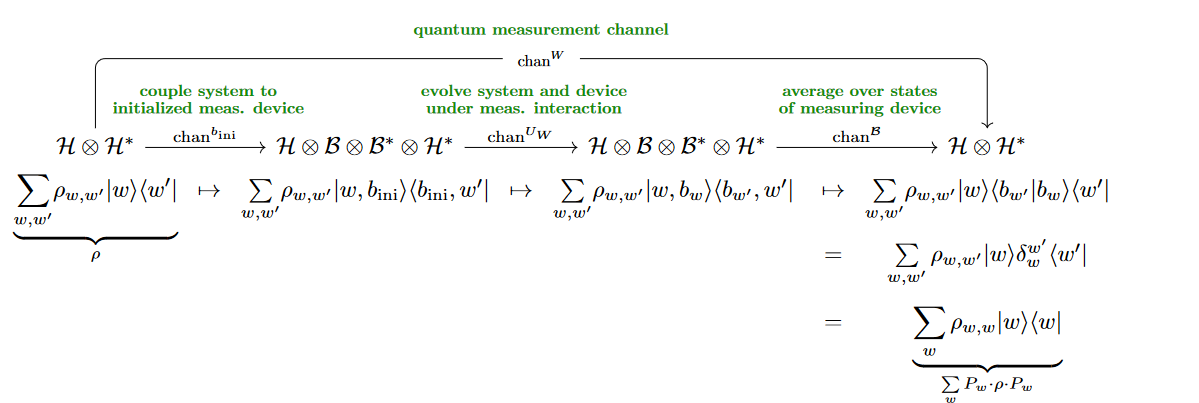
The way this works specifically for quantum measurement channels has precursor discussion von Neumann 1932 §VI.3 and received much attention in discussion of quantum decoherence following Zurek 1981 and Joos & Zeh 1985 (independently and apparently unkowingly of the general discussion of environmental representations in Lindblad 1975).
Concretely,
(we shall restrict attention to finite-dimensional Hilbert spaces not to get distracted by technicalities that are irrelevant to the point we are after)
if (we use bra-ket notation) denotes the initial state of a “device” quantum system then any notion of this device measuring the given quantum system (in its measurement basis , ) under their joint unitary quantum evolution should be reflected in a unitary operator under Zurek 1981 (1.1), Joos & Zeh 1985 (1.1.), following von Neumann 1932 §VI.3, review includes Schlosshauer 2007 (2.51):
-
the system remains invariant if it is purely in any eigenstate of the measurement basis,
-
while in this case the measuring system evolves to a corresponding “pointer state” :
for and distinct elements of an (in practice: approximately-)orthonormal basis for . (There is always a unitary operator with this mapping property (7), for instance the one which moreover maps and is the identity on all remaining basis elements.)
But then the composition of the corresponding unitary quantum channel with the averaging channel over is indeed equal to the -measurement quantum channel on (cf. eg. Schlosshauer 2007 (2.117), going back to Zeh 1970 (7)), as follows:
Noise channels
Examples of quantum noise channels:
Related concepts
References
The operator-sum decomposition characterization of completely positive maps is due to:
-
W. Forrest Stinespring, Positive functions on -algebras, Proc. Amer. Math. Soc. 6 2 (1955) 211-216 [doi:2032342, doi:10.2307/2032342]
-
Karl Kraus, General state changes in quantum theory, Ann. Physics 64 2 (1971) 311-335 [doi:10.1016/0003-4916(71)90108-4]
-
Man-Duen Choi, Completely positive linear maps on complex matrices, Linear Algebra and its Applications 10 3 (1975) 285-290 [doi:10.1016/0024-3795(75)90075-0]
with early review in:
-
David E. Evans, John T. Lewis, Dilations of irreversible evolutions in algebraic quantum theory, Communications of the Dublin Institute for Advanced Studies, Series A: Theoretical Physics 24 (1977) [eprint:34031, pdf]
-
Karl Kraus, States, Effects, and Operations – Fundamental Notions of Quantum Theory, Lecture Notes in Physics 190 Springer (1983) [doi:10.1007/3-540-12732-1]
See also
- William B. Arveson, On subalgebras of -algebras, Bull. Amer. Math. Soc. 75 (1969) 790-794 [doi:1969-75-04/S0002-9904-1969-12293-7, pdf]
The environmental representation of completely positive maps originates with
- Göran Lindblad, Completely positive maps and entropy inequalities, Commun. Math. Phys. 40 (1975) 147–151 [doi:10.1007/BF01609396]
and was then eventually rediscovered for the special case of quantum measurement channels following the 1980s discussion of decoherence.
The terminology “quantum operation” for linear maps on the linear dual of a -algebra which preserve the subset of states on a star-algebra:
- Rudolf Haag, Daniel Kastler, pp. 850 in: An algebraic approach to quantum field theory, Journal of Mathematical Physics, 5 (1964) 848-861 [doi:10.1063/1.1704187, spire:9124]
The terminology “quantum channel”:
-
Karol Życzkowski, Ingemar Bengtsson, Section 3 of: On Duality between Quantum Maps and Quantum States, Open Systems & Information Dynamics 11 01 (2004) 3-42 [doi:10.1023/B:OPSY.0000024753.05661.c2]
-
Teiko Heinosaari, Mário Ziman, Section 4 of: The Mathematical Language of Quantum Theory – From Uncertainty to Entanglement, Cambridge University Press (2011) [doi:10.1017/CBO9781139031103]
Analysis of extremal quantum channels:
-
L. J. Landau, Raymond F. Streater, On Birkhoff’s theorem for doubly stochastic completely positive maps of matrix algebras, Linear Algebra and its Applications 193 (1993) 107-127 [doi:10.1016/0024-3795(93)90274-R]
-
Christian B. Mendl, Michael M. Wolf, Unital Quantum Channels – Convex Structure and Revivals of Birkhoff’s Theorem, Commun. Math. Phys. 289 (2009) 1057-1096 [arXiv:0806.2820]
-
James Miller, S. T. da Silva, On the Extremality of the Tensor Product of Quantum Channels [arXiv;2305.05795]
Review and survey:
In the context of quantum computation:
-
Michael A. Nielsen, Isaac L. Chuang, §8.2 in: Quantum computation and quantum information, Cambridge University Press (2000) [doi:10.1017/CBO9780511976667, pdf, pdf]
-
John Preskill, §3.2 in: Measurement and Evolution, chapter 3 of: Quantum Information, lecture notes, since 2004 [pdf, web]
-
Peter Selinger, §6.3 in: Towards a quantum programming language, Mathematical Structures in Computer Science 14 4 (2004) 527–586 [doi:10.1017/S0960129504004256, pdf, web]
-
Greg Kuperberg, §1.5 of A concise introduction to quantum probability, quantum mechanics, and quantum computation (2005) [pdf, pdf]
in the context of quantum probability:
- Rolando Rebolledo, Complete Positivity and the Markov structure of Open Quantum Systems, chapter in: Stéphane Attal, Alain Joye, Claude-Alain Pillet (eds.), Open Quantum Systems II – The Markovian approach, Lecture Notes in Mathematics 1881, Springer (2006) 149-182 [doi:10.1007/b128451]
and in quantum information theory:
-
Mark M. Wilde, Quantum Information Theory, Cambridge University Press (2013) [doi:10.1017/CBO9781139525343, arXiv:1106.1445]
-
Joseph M. Renes, 4.32 in: Quantum Information Theory (2015) [pdf] De Gruyter (2022) [doi:10.1515/9783110570250]
-
Sumeet Khatri, Mark M. Wilde, §3.2 in: Principles of Quantum Communication Theory: A Modern Approach [arXiv:2011.04672]
Further:
-
Ingemar Bengtsson, Karol Życzkowski, Chapter 10 of: Geometry of Quantum States — An Introduction to Quantum Entanglement, Cambridge University Press (2006) [doi:10.1017/CBO9780511535048, ResearchGate]
-
Robert B. Griffiths, Quantum Channels, Kraus Operators, POVMs (2012) [pdf, pdf]
-
Stéphane Attal, Quantum Channels, Lecture 6 in: Lectures on Quantum Noises [pdf, pdf, webpage]
See also
-
Caleb J. O’Loan, Topics in Estimation of Quantum Channels, PhD thesis, University of St. Andrews (2009) [arXiv:1001.397]
-
John A. Smolin, Frank Verstraete, Andreas Winter, Entanglement of assistance and multipartite state distillation, Phys. Rev. A 72 (2005) 052317 (arXiv:quant-ph/0505038)
-
John Watrous, Mixing doubly stochastic quantum channels with the completely depolarizing channel (2008) (arXiv)
-
Wikipedia, Quantum Operation
The description of completely positive maps in terms of dagger-categories (see at quantum information theory via dagger-compact categories) goes back to
-
Peter Selinger, Dagger-compact closed categories and completely positive maps, Electronic Notes in Theoretical Computer Science, 170 (2007) 139-163 [doi:10.1016/j.entcs.2006.12.018, pdf]
-
Bob Coecke, Complete positivity without compactness, 2007 (pdf)
This is further explored in:
-
Bob Coecke, Eric Paquette, Dusko Pavlovic, Classical and quantum structures (2008) [pdf, pdf]
-
Bob Coecke, Chris Heunen, Pictures of complete positivity in arbitrary dimension, EPTCS 95, 2012, pp. 27-35 (arXiv:1110.3055)
-
Bob Coecke, Chris Heunen, Aleks Kissinger, Categories of Quantum and Classical Channels (arXiv:1305.3821)
For the universal property, see
- Mathieu Huot, Sam Staton, Universal properties in quantum theory (QPL 2018) (pdf).
On quantum channel capacity:
-
Alexander S. Holevo, Quantum Systems, Channels, Information – A Mathematical Introduction, Studies in Mathematical Physics 16, De Gruyter (2013) [doi:10.1515/9783110273403]
-
Alexander S. Holevo, Quantum channel capacities, Quantum Electron. 50 440 (2020) [doi:10.1070/QEL17285/meta]
Last revised on September 28, 2023 at 10:34:39. See the history of this page for a list of all contributions to it.